B2B fabric wholesale site with a visual materials library
2026
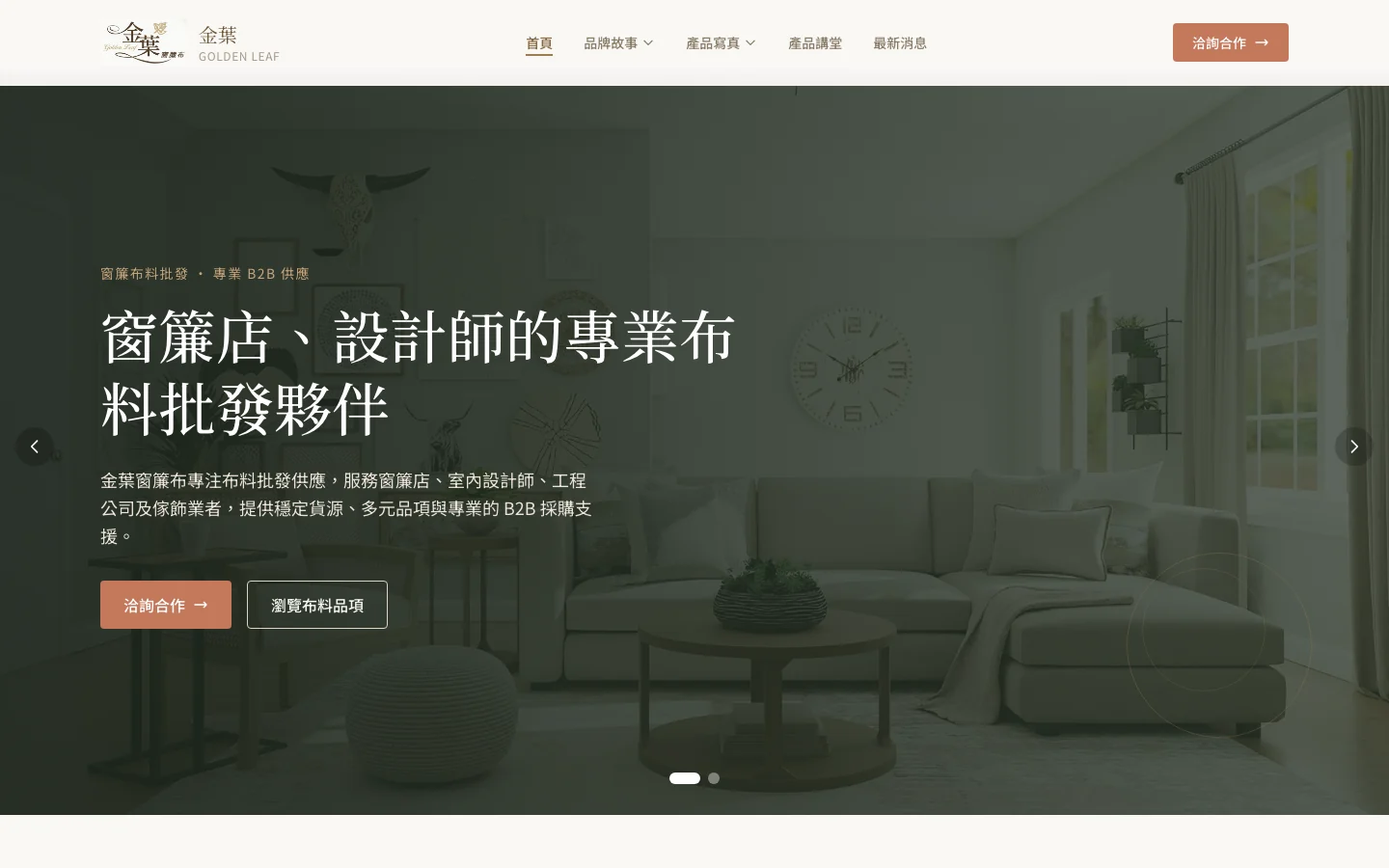
Golden Leaf is a wholesale supplier of curtain fabrics selling to curtain retailers, interior designers, contracting firms and soft-furnishing businesses — not to end consumers. The range spans blackout fabrics, sheers, water-resistant technical textiles, imported leathers, synthetic leathers, scratch-resistant and cooling fabrics, running to several hundred materials.
A B2B wholesale site works on completely different logic to a consumer store. Visitors are trade buyers, and what they want to know is whether you stock what they need, whether supply is reliable, and whether they can order a small sample first — not how to add something to a basket. The whole site therefore narrows to two goals: browse the materials, then raise an enquiry or request a sample.
The content architecture deliberately separates the visual gallery from the knowledge hub. The gallery serves established customers who already know what they are after; the knowledge articles serve designers and new buyers still comparing materials, and pick up long-tail search traffic along the way.
A photography-led materials library so trade buyers can scan texture, weave and colour quickly, fully categorisable and maintainable from the admin panel
Articles comparing materials and explaining how to choose, serving buyers still evaluating options while earning long-tail organic search traffic
About, brand introduction, certifications and applications are split into four sub-pages, addressing the "can I rely on this supplier" question B2B buyers care most about
Every call to action across the site funnels to one place — enquire or request samples — so trade visitors never have to guess which entry point is theirs
New stock arrivals, trade shows and notices with scheduling and cover images, giving regular customers a reason to come back
Reliable supply, consistent quality, breadth of range, expert advice and flexible terms are stated explicitly, answering the trade buyer's decision criteria head on
The whole site is server-rendered so both the materials and the articles are fully crawlable rather than appearing only after JavaScript executes
Materials, galleries, articles, news, enquiries and SEO fields are all maintained by the client without developer involvement
A consumer store pushes visitors toward a basket, but a fabric wholesale deal closes over quotes and samples, not online checkout — there is no fixed retail price to publish. So the site carries no cart or payment flow. Instead every call to action funnels into enquiry and sample requests, and the form captures materials, quantity band and intended use so the sales team knows the size of the opportunity immediately.
The front end is built on Astro 5 with server-side rendering. Materials and knowledge articles are assembled server-side before they are sent, so Google and AI search receive complete HTML; interactive components hydrate as Vue 3 islands only where needed.
Fabric is bought by eye, so the data model puts imagery first: each material carries multiple styled and detail shots and is classified by composition, function and application. Uploads generate several size variants automatically, so a thumbnail grid never pulls full-resolution photography.
Questions like "how are blackout grades classified" or "what actually is scratch-resistant fabric" are searched by designers and end customers alike. Publishing them as standalone articles serves customers and creates a durable organic entry point that keeps feeding new trade enquiries.
Materials, categories, articles, news, enquiries and SEO settings all move over GraphQL. The typed schema keeps front and back end in step, and adding fields later — fabric width, composition, lightfastness rating — does not disturb existing queries.
The admin covers materials and categories, the image library, knowledge articles, scheduled news, enquiry handling with status tracking, and SEO fields. Unread enquiries pin to the top so no new customer is missed.
The conversion goal is the difference. E-commerce wants the item in a basket and the card charged; a wholesale deal closes through quoting and sample exchange, with pricing set by volume and ongoing terms, so there is no fixed price to publish in the first place. Forcing a cart onto that model does not help. The site should funnel to enquiries and samples instead, and capture materials, quantity band and intended use in the form so the sales team already knows the scale of the opportunity before they reply.
It does, and it is the most cost-effective acquisition channel over time. Curtain retailers and interior designers search things like "how are blackout grades classified" or "what is scratch-resistant fabric made of" while they are selecting materials — steady volume with clear intent. Publishing those as standalone articles puts the brand in front of buyers while they are still comparing, and it also gives Google and AI search a much stronger signal that this site has genuine subject expertise in curtain fabrics.
It would, if left unmanaged. The classic mistake on a fabric site is uploading the raw photography — two or three megabytes an image, fifteen of them on a page. Here uploads automatically generate several size variants, the front end requests the one that matches its actual display size, and everything is served as WebP with lazy loading, so a thumbnail grid never downloads a 2000px original to show a 300px tile.
CONTACT US
B2B wholesale sites, product galleries, knowledge hubs, a back office your team can run — we build the whole thing to fit.
Get in touch