Australian WPC building-materials site with a decking calculator
2026
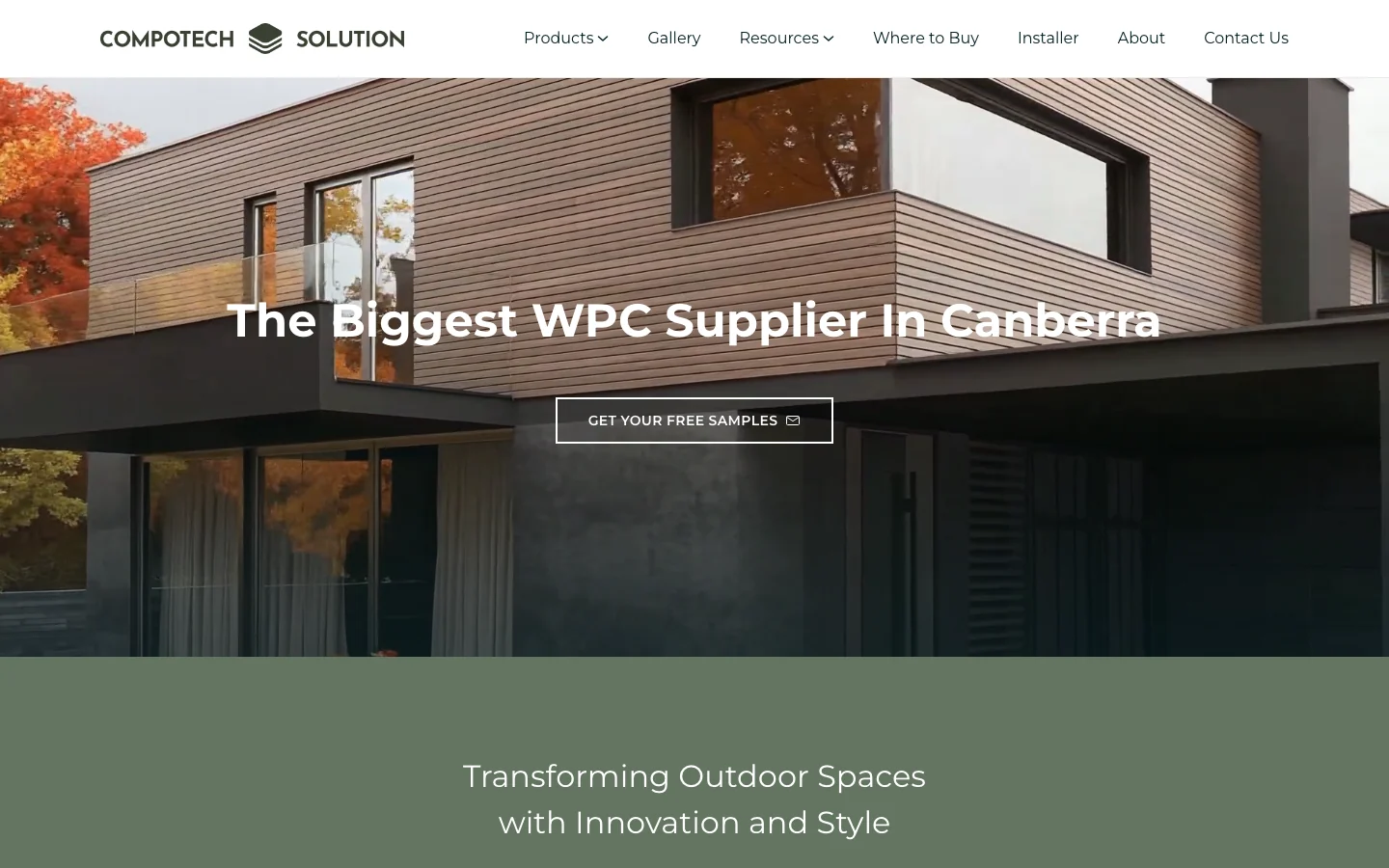
Compotech Solution supplies wood-plastic composite (WPC) building materials from Canberra, ACT. Their range covers composite decking, composite cladding and PVC decking produced with co-extrusion technology, serving homeowners, builders, architects and commercial clients alongside a wholesale and installer network.
The brief here was not brand storytelling — it was helping buyers pin down specifications. Anyone buying decking wants to know dimensions, colours, how much material they need and how it goes together. So the site is built around the product catalogue, supported by a material calculator, installation guides, warranty terms and a stockist finder that answer the pre-sales questions up front.
The front end runs on Astro SSR so the English-language catalogue is fully crawlable. A Laravel and GraphQL back end feeds the data, with a Filament admin panel that lets the client maintain products, galleries and enquiries without a developer.
Composite Decking, Composite Cladding and PVC Decking are presented as separate lines, each with dimensions, colours, surface finish and specification fields buyers can compare directly
Homeowners and contractors enter their area dimensions and get an estimated board count — turning the single most common pre-sales question into self-service
Sample requests are the primary conversion path. Buyers need to handle the texture and colour before committing, which fits the real sales process far better than a checkout flow
Completed residential and commercial installations show the material in real settings, fully manageable from the admin panel
Step-by-step guides, FAQs and warranty terms in one place, reducing the after-sales support load from installers and DIY customers
Separate Where-to-Buy and Installer modules help buyers find a nearby supplier or an accredited fitter, supporting the wholesale channel strategy
A dedicated path for merchants, hardware channels and contracting firms keeps trade enquiries separate from retail ones instead of merging both into one form
Products, galleries, stockists, enquiries and SEO fields are all client-maintainable through form and list views that need no technical background
Australian trade buyers compare suppliers through Google, so the front end uses Astro SSR: above-the-fold content is assembled server-side, guaranteeing that search engines and AI crawlers receive complete HTML rather than product data that only appears once JavaScript runs.
Building materials differ by specification, not by copy. Dimensions, colours, surface texture, suitable applications and pack sizes are modelled as discrete fields, so the front end can filter on them and the client does not have to rewrite a description every time a product is added.
The calculator derives board quantities and an allowance for waste from the area dimensions and the chosen product, computed entirely client-side. It also doubles as a lead path: the result carries straight into the sample request form.
Products, categories, galleries, stockists, installers and enquiries all move over GraphQL. A typed schema lets front and back end progress independently, and the client fetches only the fields it needs, saving bandwidth on mobile.
The admin covers products and categories, the project gallery, stockists, the installer directory, enquiry handling with status tracking, and SEO fields. Unread enquiries are pinned to the top so nothing gets missed.
The client is in Australia and the team is in Taiwan. Requirements were locked in over a small number of video sessions, with a shared online progress board carrying the day-to-day status, and every date in the admin renders in the client's local time zone.
Decking and cladding are high-value, high-consideration purchases, and colour and surface texture look markedly different on screen than in the hand. Buyers essentially never commit without handling a physical sample. Making the sample request the conversion goal therefore tracks the real path to a sale far better than forcing a checkout: once the customer has confirmed the finish, the conversation moves to quantities, trade pricing and freight — a stage that needs a salesperson anyway.
The most common pre-sales question in this trade is "how many boards do I need for this area?" Answering that by hand consumes a lot of sales time, yet buyers who cannot work out a quantity tend not to enquire at all. Turning it into an instant client-side tool lets prospects do that homework themselves, and carrying the result into the sample request form means every enquiry arrives with a concrete scope attached, which makes quoting much faster.
The real risk on a cross-border project is not technical, it is the round-trip delay a time difference introduces. We concentrate requirements into a small number of video sessions that set direction, then run the build against a shared online progress board so the client can see status and open decisions without waiting for a meeting. Every date and time in the admin also renders in the client's own time zone, so nothing is misread.
CONTACT US
Product catalogues, specification calculators, stockist finders, a back office your team can actually run — we build the whole thing to fit.
Get in touch