Matching, marketplace, courses, community — one account for all of it
Web + App
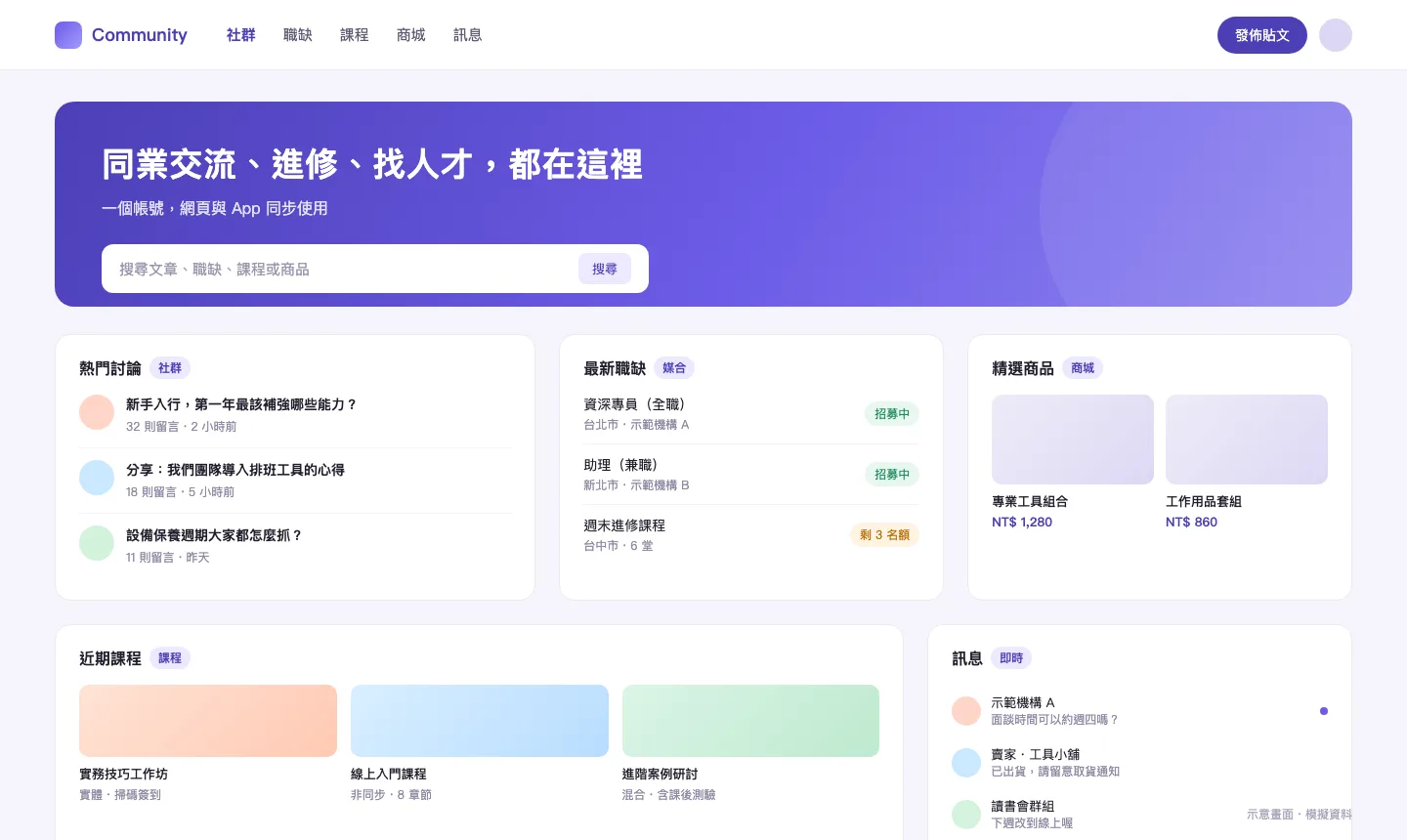
An integrated platform built for a single professional industry. The client wanted practitioners and organisations in that field to hire, buy, train and talk with peers in one place instead of across scattered websites and chat groups.
We split it into five modules — verification, talent matching, a multi-seller marketplace, courses and community — on top of one shared layer for membership, payments, real-time messaging and administration. One account works on both the website and the mobile app.
The website is built with Astro + Vue 3, the mobile app with Flutter (iOS + Android), the API with Laravel and the admin panel with Filament. The platform keeps growing in phases after launch.
Users with different roles sign in with one account on the web or app, pass identity verification, then reach the four modules. The modules refer traffic to each other and all sit on one shared layer of accounts, payments, real-time messaging and administration.
Regular members, verified professionals and organisations each follow their own verification flow; some features stay locked until verification passes, so users know they are dealing with real peers
Works like 104, Taiwan’s largest job bank: candidates build resumes, search and apply for openings; organisations set up company pages, post jobs, screen candidates and send interview invitations — two interfaces on the same platform
Like Shopee, members can open their own shop, list products and manage orders; buyers message sellers in-app and leave reviews after purchase. The platform handles payments, home delivery and convenience-store pickup, e-invoices and returns
Not an off-the-shelf course platform — built from scratch around how the client actually runs classes: instructors manage course content; students enrol and pay, check in on site by QR code, then take quizzes and leave reviews
Works like Dcard, Taiwan’s popular board-based forum: topic boards with posts, comments, likes, bookmarks and reporting, plus member-run groups — and WebSocket chat so buying, hiring and networking conversations all happen inside the platform
A Flutter app for both platforms shares the same API as the website; one admin panel handles every kind of identity, content and transaction review
The website (Astro SSR + Vue 3) and the Flutter app share the same Laravel API. The website renders on the server for SEO and fast first paint, loading JavaScript only where interaction is needed; the app focuses on what phones do best — notifications, QR scanning and photo uploads.
Individuals, verified professionals and organisations each see and do different things. Verification runs in stages, and unverified accounts stay within a limited scope so the platform is not flooded by users outside the target audience.
The marketplace follows a Shopee-style multi-seller model: every seller gets their own shop and order dashboard, while the platform collects payment and handles logistics in the middle, and buyer–seller chats and reviews stay on the platform. Marketplace and course orders each use a state machine for payment, shipping and returns, so every step can only move to a valid next step. ECPay payments, convenience-store logistics and e-invoices are integrated, and payment results are trusted only after backend verification.
WebSocket chat with Redis caching for fast reads. One chat-room mechanism serves product enquiries, hiring conversations and community direct messages, instead of rebuilding chat for each module.
Uploaded images are screened by cloud image recognition before entering manual review. Identity, resume, return and report reviews are handled in one admin panel with a full audit trail.
A Filament admin panel covers marketplace, matching, courses, content and community management, with role-based access control (RBAC) so each operations team sees only what it needs.
People in the same industry have connected needs: finding work, training, purchasing and talking with peers. Four separate systems would mean integrating accounts, payments and notifications four times, and users switching back and forth. One platform shares a single membership, payment, messaging and admin layer, which lowers build and maintenance cost and lets the modules feed traffic to each other.
A system with Web plus iOS/Android, payment integration and real-time messaging usually needs 4–6 months for the first release, then grows module by module based on real usage. We recommend getting one or two core modules solid first and expanding from there.
Payments go through ECPay, and an order only changes state after the backend verifies the payment callback — the frontend cannot alter it. Verification is multi-stage and restricts features until approved. Uploaded images are first screened by cloud image recognition, then reviewed manually in the admin panel, and every moderation action is logged.
CONTACT US
Whether it's a multi-functional platform, mobile app development, or e-commerce payment integration, we can tailor a solution for you.
Contact Us