Three.js Interactive 3D Product Showcase
2025
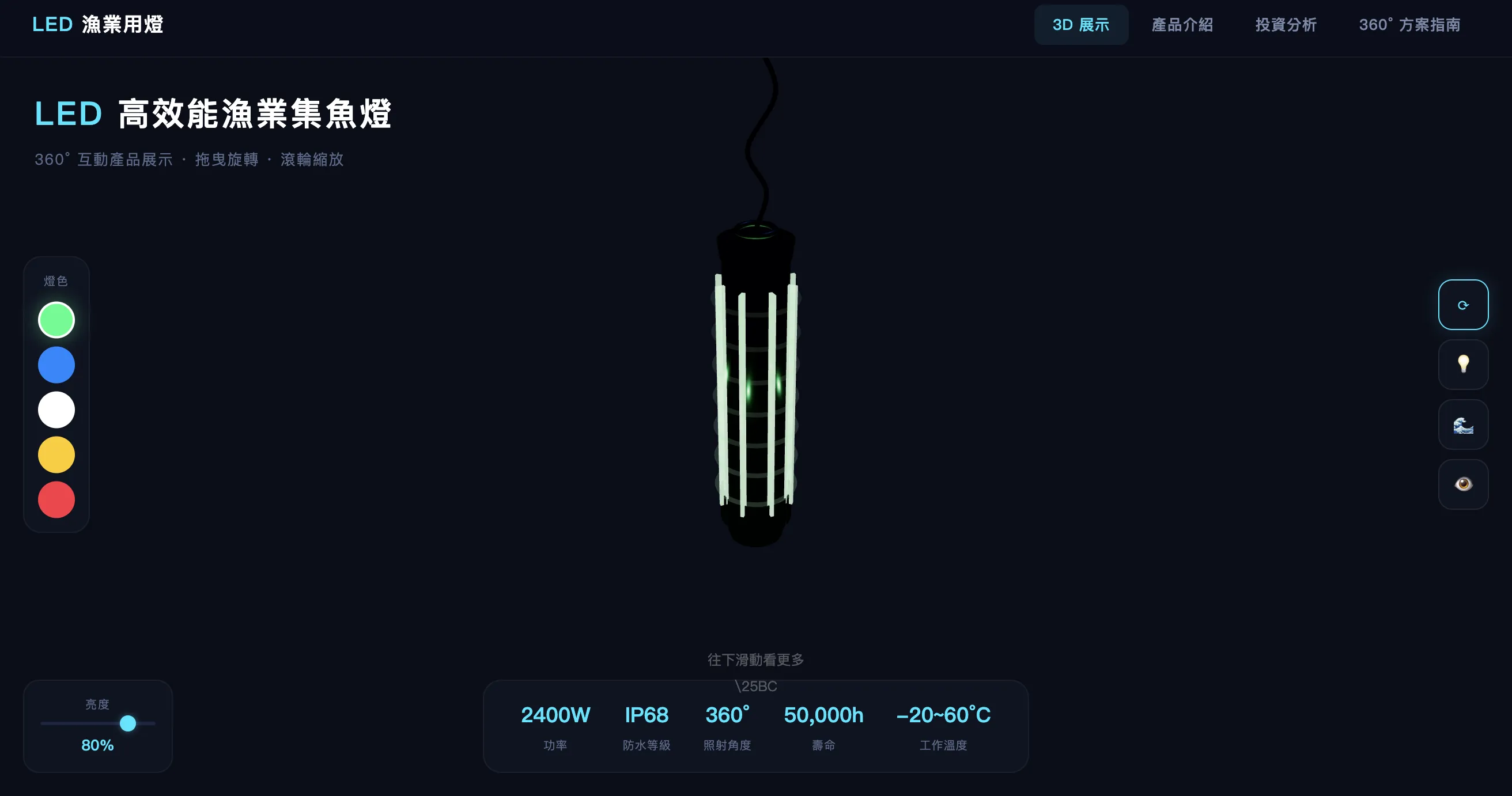
360° Panoramic View is an interactive 3D product showcase page built with Three.js, featuring a high-performance LED fishing light as the demo product, allowing users to inspect product details from any angle via drag rotation and scroll zoom.
The page integrates 3D real-time rendering, multi-color light switching, underwater scene simulation, X-ray perspective mode, and other interactive features, combined with product specifications, traditional fixture comparison tables, and ROI analysis for both visual appeal and sales persuasion.
Developed with pure HTML5 + CSS3 + JavaScript, requiring no build tools. Three.js is loaded via ES Module Import Map and deployed on Netlify for instant preview.
Supports mouse drag rotation and scroll zoom, allowing users to inspect product details from any angle with auto-rotation to present the full appearance
Offers five light colors — green, blue, white, yellow, and red — with instant switching. LED panels, glow rings, and particle effects update colors simultaneously
Built-in toggle for lights on/off, underwater scene, X-ray perspective, and more viewing modes to fully demonstrate product performance in different environments
Integrates detailed product specification tables, traditional fixture comparison charts, and return on investment analysis, combining showcase and sales capabilities
Uses Three.js 0.163 as the core rendering engine, loaded from CDN via ES Module Import Map with no bundling tools required. The renderer enables ACES Filmic Tone Mapping (exposure 1.2) and PCF Soft Shadow Map to achieve cinematic lighting quality.
The scene incorporates FogExp2 exponential fog (density 0.012) to create a deep-sea depth-of-field atmosphere. The camera uses PerspectiveCamera (FOV 45°) paired with OrbitControls for drag rotation (damping factor 0.06) and scroll zoom (distance 4–18).
The LED fishing light is built entirely through procedural modeling (Procedural Modeling) with no external 3D files. The main body consists of CylinderGeometry (32-sided smooth cylinder), with separate geometries for the top and bottom caps. The hook uses TorusGeometry, and the cable is generated with Catmull-Rom curves combined with TubeGeometry.
Eight LED panels are arranged in a circular pattern using BoxGeometry (angle = i/8 × 2π), with MeshPhysicalMaterial featuring emissive (self-illumination), transmission: 0.3 (glass refraction), and opacity: 0.95 (semi-transparency). Seven glow rings are stacked using TorusGeometry with opacity 0.3 for a soft halo effect.
Dynamic lighting consists of 4 ring-arranged PointLights + 1 central PointLight, with intensity adjustable in real-time via the brightness slider. Ambient light (0x1a2a4a) and directional light (0x4466aa) provide base illumination.
LED panels use a sine wave pulse animation (2 Hz) to simulate a breathing light effect: pulse = 0.85 + sin(t×2) × 0.15. The underwater scene uses dual-frequency sin/cos waveforms to produce realistic waves, combined with a particle system (continuous upward float animation) to create underwater bubble effects.
Six interactive controls are provided: auto-rotation (1.5°/frame), lights on/off (emissive intensity 0–2.5), underwater scene (wavy plane + particle effects), X-ray perspective (wireframe + opacity 0.15), light color selection (green/blue/white/yellow/red instant switch), and brightness slider (0–100% continuous adjustment).
When switching colors, all visual elements update simultaneously: LED panel color/emissive, PointLight color, glow ring emissive, and particle system colors, ensuring visual consistency.
Pixel Ratio is capped at Math.min(devicePixelRatio, 2) to prevent excessive rendering on high-DPI devices. The 3D Canvas only covers the Hero section (not full page) to reduce GPU load. Camera damping (dampingFactor 0.06) provides smooth inertia-based interaction, while FogExp2 naturally clips distant objects to reduce draw calls.
Geometries use a sharing strategy — glow rings are created once and repositioned multiple times, cooling fins share the same BoxGeometry, while materials are independent instances per element to avoid state pollution. Animations are driven by Clock-based Delta Time to ensure consistent animation speed across different frame rates.
The page is developed with pure HTML5 + CSS3 + JavaScript ES Module, no framework or bundling tools. Three.js is loaded via Import Map from jsDelivr CDN. CSS uses CSS Grid / Flexbox layout with Glassmorphism (blur 12–16px) panel styling.
Responsive design uses 768px as the breakpoint, switching to single-column layout and collapsible navigation on mobile. Deployed on Netlify with static files published directly (no build step), configured with X-Frame-Options: DENY and X-Content-Type-Options: nosniff security headers.
A product showcase page like this is typically a single marketing page that rarely changes, so it doesn't need a complex framework or build pipeline. It's built with pure HTML5 + CSS3 + JavaScript ES Modules, loading Three.js directly from a CDN via an Import Map — skipping the build step entirely and deploying straight to Netlify. This keeps maintenance and handover simple while keeping the page lightweight.
This project was completed in 2025. The core work is procedural modeling — building the product entirely in code rather than importing external 3D files — combined with multiple lighting, material, and interaction modes. A single-product Three.js showcase of this scope typically takes about 2–4 weeks, with most of the time spent tuning the 3D model and polishing the various viewing modes such as lights on/off, underwater scene, and X-ray perspective.
Yes. The procedural modeling, real-time lighting pipeline, instant color switching, and multi-mode viewing are all reusable building blocks — swap the geometry parameters and material settings, and the same approach extends to other products that need a 360° interactive showcase, such as furniture, appliances, or luxury accessories for e-commerce or marketing sites.
CONTACT US
Whether it's 3D product showcases, interactive web pages, or WebGL visualization projects, we can build a tailored solution for you.
Contact Us